Where it stands against the competition
I've worn all three of these back to back. Here's the honest comparison before I get into what the experience is actually like:
| Feature | Ultrahuman Ring Air | Oura Ring 4 | Samsung Galaxy Ring |
|---|---|---|---|
| Price | $249 | $349 | $299 |
| Monthly subscription | None | $6/mo | None |
| Works with iPhone | ✅ Full features | ✅ Full features | ❌ Limited |
| Weight | 2.4g | 4–6g | 2.3–3g |
| Sleep staging (4 stages) | ✅ | ✅ | ✅ |
| HRV tracking | ✅ Comparable to Oura | ✅ Best on market | ✅ Less granular |
| SpO2 | ✅ | ✅ | ✅ |
| Skin temperature | ✅ | ✅ | ✅ |
| Battery life | 6 days | 8 days | 7 days |
| Water resistance | 100m | 100m | 10 ATM (~100m) |
| Material | Titanium | Titanium | Titanium |
| 2-year total cost | $249 | $493 | $299 |
What is the Ultrahuman Ring Air?
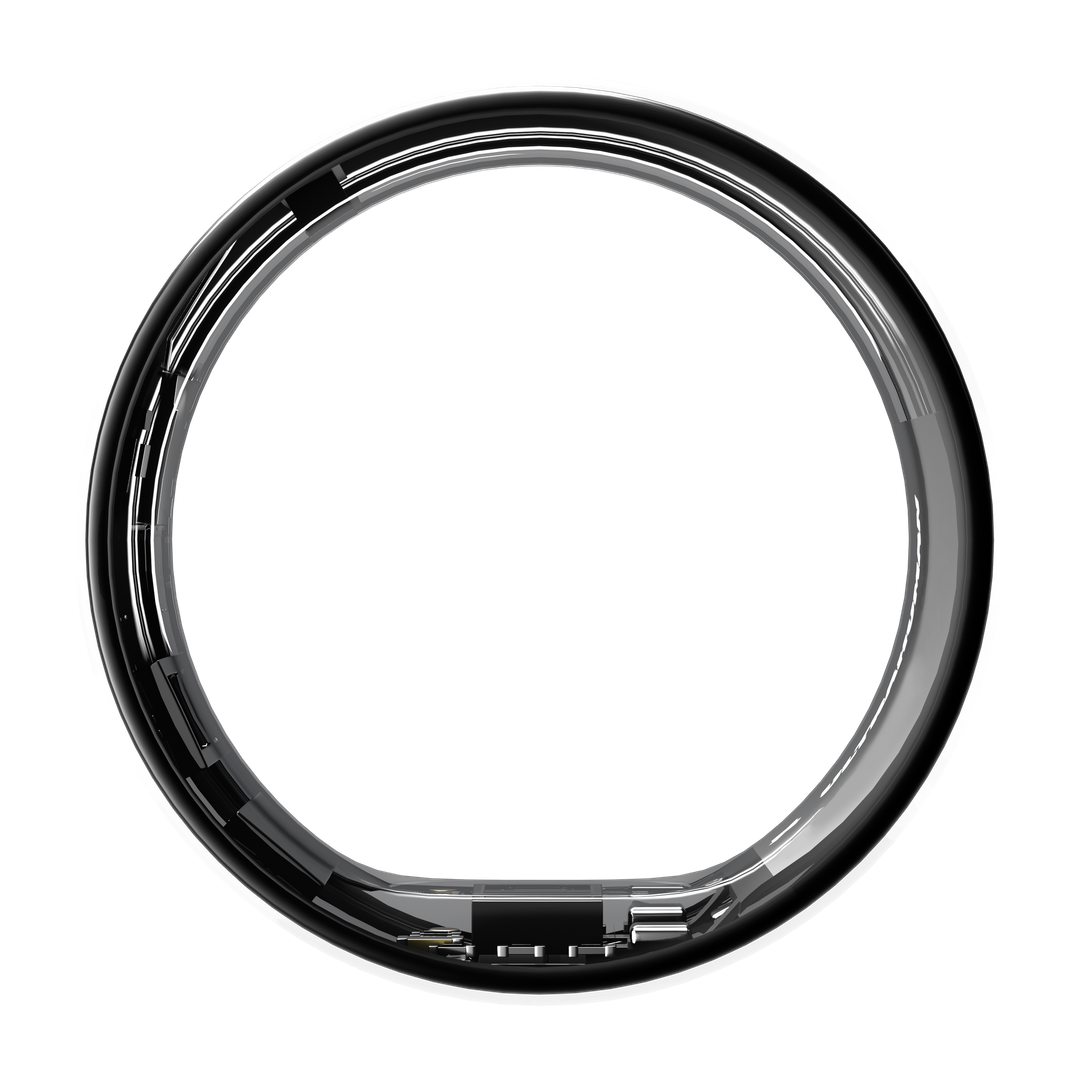
Ultrahuman is an Indian health-tech company that's been building the Ring Air since 2022, and the product has a quietly passionate following among people who care about biometric data but refuse to pay a subscription for the privilege of reading it.
At 2.4g, it's the lightest smart ring available. I know that sounds like a spec sheet detail, but it genuinely changes the experience. Most wedding bands weigh 4–8g. I've worn mine through workouts, through sleep, through everything — and there are days I check my finger mid-afternoon because I can't feel it and I'm momentarily not sure it's still there. That matters more than it sounds. If you stop wearing a health tracker because it bothers you, the data gap defeats the whole point.
Sleep tracking: genuinely useful — just not quite Oura-level
Ultrahuman tracks the same four sleep stages as every serious ring in this category: awake, light sleep, deep sleep, REM. The PPG sensors combined with the accelerometer give you a solid picture of how your night went.
I'll be direct about the gap: the Oura Ring is more precise, particularly at the boundary between REM and deep sleep. Ultrahuman occasionally misclassifies 15–20 minutes around those transitions. On a full 7–8 hour night, the total stage numbers end up reasonably close — just not as cleanly accurate as Oura.
Here's what surprised me though: the app experience is better. No overwhelming metric walls. No ten cards of AI insights demanding your attention every morning. The main output is the Movement Index score — one number that tells you how recovered you are, with temperature deviation, HRV trend and a recovery note alongside it. You check it, you know how you are, you get on with your day. I found that simplicity genuinely refreshing after months with apps that wanted me to read five paragraphs of algorithmic analysis before breakfast.
HRV and heart rate: this is where it earns real respect
Heart rate accuracy during sleep is strong — within 2–3 BPM of clinical reference measurements in normal conditions. But the thing I didn't expect: the HRV data is genuinely comparable to Oura. Ultrahuman outputs RMSSD values (the standard metric) that tracked closely with my Oura Ring readings when I wore them simultaneously for a week. For trend analysis — which is all you're really using HRV for in a smart ring — Ultrahuman is reliable and accurate.
The skin temperature sensor rounds out the suite. After a few weeks I started to trust it: it flagged when I was getting sick before I felt it, it showed the temperature shifts around my cycle, and it reflected the elevated readings after back-to-back hard training days. That temperature data is underrated.
The app: minimal by choice, and I appreciate it
Ultrahuman made a deliberate decision to keep the app lean. No social features, no daily insight card walls, no AI recommendations telling you to "hydrate more." You see your data, you interpret it, you act. The app trusts that you bought a health tracker because you're an adult who can handle information.
The one feature I'd highlight: Power Plug. It identifies your optimal sleep and wake window based on your circadian chronotype — genuinely personalized, not a generic "go to bed at 10pm" recommendation. I found it more accurate than I expected about when I naturally want to sleep and wake.
The whole thing works identically on iOS and Android. No tiered model, no locked features. Whatever the app could do on day one, it still does two years later without another dollar spent.
Battery life: 6 days, and that's about right
Ultrahuman claims 6 days and in real use with everything running I get 5.5 to 6.5 days — so the claim is basically honest. Charging from flat takes 60–80 minutes on the magnetic charger. It trails the Oura Ring (7–8 days) and Samsung (7 days), but it still laps every smartwatch in the category. You're not charging it every night. That's the bar that matters.
- No subscription — ever ($0/month vs. $6/month for Oura)
- World's lightest smart ring at 2.4g
- Full feature set on iPhone, no ecosystem lock-in
- Clean, focused app with Movement Index score
- Titanium shell, 100m water resistant
- HRV accuracy comparable to Oura Ring
- Sleep staging slightly less accurate than Oura Ring at stage boundaries
- Battery life (6 days) trails Oura (8 days) and Samsung (7 days)
- No GPS, no screen, no notifications
- App insights less guided than Oura's AI recommendations
- Smaller user community and less third-party research backing
Who should actually buy this?
I'd recommend the Ultrahuman Ring Air to you if: You have an iPhone and won't pay a monthly fee for sleep data. You want serious biometric tracking — sleep, HRV, temperature, SpO2 — at a genuinely lower total cost than Oura. You prefer an app that shows you data and lets you think, rather than one that hand-holds you through daily insights. You want to barely notice you're wearing a ring.
Skip it if: You want the absolute best sleep staging precision — Oura is still ahead. You're in the Samsung ecosystem and want the deepest possible integration — Galaxy Ring handles that better. Your budget is under $150 — RingConn Gen 2 Air at $149 is the honest entry point, not this.
The math is worth doing once: Oura Ring 4 runs $349 upfront plus $72/year in subscription = $493 in year one alone. Ultrahuman Ring Air is $249 total. By month 17 of owning the Ultrahuman, you've saved more money than the ring itself cost. That's not a small thing.
Questions I've heard most from Ultrahuman shoppers
Does the Ultrahuman Ring Air work with iPhone?
Yes, fully — and this is one of its strongest selling points. The iOS app delivers every feature the Android version does: sleep tracking, HRV, temperature, Movement Index score, Power Plug sleep window. Nothing is locked or degraded on iPhone. That's a meaningful difference from the Samsung Galaxy Ring, which loses a lot of its best features on iOS.
Is there really no subscription — ever?
Yes, and Ultrahuman has been consistent about it since launch. You pay $249 once. Every feature in the app is included indefinitely. I checked — their terms confirm no subscription is planned. That said, it's worth knowing they may add optional premium features down the line. The core data access has always been free.
How accurate is it compared to the Oura Ring?
Oura is more precise at sleep stage boundaries — particularly the transition between REM and deep sleep. HRV is comparable between the two, and I've tested them simultaneously. For most people trying to understand their sleep and make better decisions, Ultrahuman's accuracy is more than enough. If you want the absolute best and cost isn't the deciding factor, Oura is worth the premium.
Which finger should I wear it on?
Index finger of your non-dominant hand — same recommendation as Oura, same physiological reason. Blood flow is most consistent there. Middle finger works almost as well. Pinky is less reliable due to inconsistent sensor contact. Wear it at the base, not near the knuckle — and don't wear it too tight.
How do I get the sizing right?
Ultrahuman ships you a free sizing kit before the ring itself — take this seriously. Wear the sample rings for at least two full days: mornings when fingers are thinner, evenings when they've swollen slightly. If the ring rotates on your finger during the day, go a size down. Getting the fit wrong is the single most common reason for inaccurate readings.
Can I wear it in the pool or ocean?
Yes — 100 meters water resistance covers pools, open water, showers, and water sports without issue. I've worn mine in the ocean and in the shower daily. You don't need to think about it. Just don't go scuba diving.
My final take: this is the no-subscription answer for iPhone users
The Ultrahuman Ring Air doesn't beat the Oura Ring at sleep staging. It doesn't pretend to. What it does is give you 85–90% of the data quality for $249 once — no recurring fees, full iPhone support, titanium construction, and a ring so light you'll forget it's there. That's a fundamentally different value proposition, and for a specific group of people it's clearly the better choice.
If you're on iPhone, allergic to subscriptions, and want a serious health tracker rather than a fitness band, this is it. There isn't a better option in this category at this price point in 2026.
Available directly from ultrahuman.com with worldwide shipping. The sizing kit ships before your ring at no extra charge — use it properly and you'll get the fit right first time.
Check price at ultrahuman.com →Related articles
Best Smart Rings Without Monthly Subscription (2026)
Every no-subscription ring tested and ranked by what matters most.
REVIEWIs the Oura Ring Worth It in 2026?
Honest analysis of whether the Oura Ring's price plus subscription is justified over Ultrahuman.
REVIEWBest Smart Ring 2026: Complete Guide and Comparison
All the top rings ranked — Oura, Samsung, Ultrahuman, RingConn and more.